Covid-19 Delta Variant Spreading – How to Be Safe?
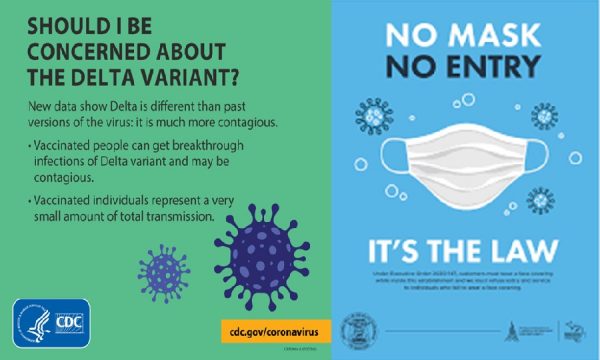
Growing Delta Variant is a concern around the world. Center For Disease Control recently revised and updated the information for fully vaccinated people. Delta variant seems to be more contagious than the other variants.
Fully vaccinated people can also transmit the virus variant to others. How to be safe and keep others safe? Follow the same rules and regulations, hygiene practices that you have been following from past one year. CDC’s updated information are below:
Updated information for fully vaccinatedpeople given new evidence on the B.1.617.2 (Delta) variant currently circulating in the United States (& other countries – Healthy Life).
Added a recommendation for fully vaccinated people to wear a mask in public indoor settings in areas of substantial or high transmission.
Added information that fully vaccinated people might choose to wear a mask regardless of the level of transmission, particularly if they are immunocompromised or at increased risk for severe disease from COVID-19, or if they have someone in their household who is immunocompromised, at increased risk of severe disease or not fully vaccinated.
Added a recommendation for fully vaccinated people who have a known exposure to someone with suspected or confirmed COVID-19 to be tested 3-5 days after exposure, and to wear a mask in public indoor settings for 14 days or until they receive a negative test result.
CDC recommends universal indoor masking for all teachers, staff, students, and visitors to schools, regardless of vaccination status.
Safer Activities for You and Your Family
Friends and family grilling outside
If you are fully vaccinated, you can participate in many of the activities that you did before the pandemic.
To maximize protection from the Delta variant and prevent possibly spreading it to others, wear a mask indoors in public if you are in an area of substantial or high transmission.
Wearing a mask is most important if you have a weakened immune system or if, because of your age or an underlying medical condition, you are at increased risk for severe disease, or if someone in your household has a weakened immune system, is at increased risk for severe disease, or is unvaccinated. If this applies to you or your household, you might choose to wear a mask regardless of the level of transmission in your area.
You should continue to wear a mask where required by laws, rules, regulations, or local guidance.
If you’ve been fully vaccinated:
You can resume activities that you did prior to the pandemic.
To reduce the risk of being infected with the Delta variant and possibly spreading it to others, wear a mask indoors in public if you are in an area of substantial or high transmission.
You might choose to wear a mask regardless of the level of transmission if you have a weakened immune system or if, because of your age or an underlying medical condition, you are at increased risk for severe disease, or if a member of your household has a weakened immune system, is at increased risk for severe disease, or is unvaccinated.
If you travel, you should still take steps to protect yourself and others.
Wearing a mask over your nose and mouth is required on planes, buses, trains, and other forms of public transportation.
You should still watch out for symptoms of COVID-19, especially if you’ve been around someone who is sick. If you have symptoms of COVID-19, you should get tested and stay home and away from others. If your test is positive, isolate at home for 10 days.
People who have a condition or are taking medications that weaken the immune system, should continue to take all precautions recommended for unvaccinated people until advised otherwise by their healthcare provider.
What We Know
COVID-19 vaccines are safe and effective at preventing COVID-19, including severe illness and death.
COVID-19 vaccines are effective against severe disease and death from variants of the virus that causes COVID-19 currently circulating in the United States, including the Delta variant.
Infections happen in only a small proportion of people who are fully vaccinated, even with the Delta variant. When these infections occur among vaccinated people, they tend to be mild.
If you are fully vaccinated and become infected with the Delta variant, you can spread the virus to others.
People with weakened immune systems, including people who take immunosuppressive medications, may not be protected even if fully vaccinated.
What We’re Still Learning
How long COVID-19 vaccines can protect people.
For more updated information on care and safety instruction guidelines for Delta variant please visit:
Apart from common cold, fever and allergy issues kids also suffer from many other health issues that parents should be aware of. Many of these health issues go unnoticed or children might not able to express what is going on with them or they will be scared to express the issues that is happening.
It is good for both parents to sit and talk about certain health concerns with children once a while to understand what might be happening in child’s health. These kind of talks and discussion will help children to open with parents and might learn to seek help from known adults.
Let us look at what are these major health concerns that parents must be aware of:
Obesity: During this Covid-19 pandemic,obesity is one of the biggest concerns for kids. Obesity is one of the major problems in most countries. Obesity could lead to serious health conditions including type 2 diabetes, cancer, depression, sleep problem, heart conditions.
Drug and alcohol abuse: Even though there is positive trend with decline indrug usage, young adults continue using alcohol, cigarettes, pain relievers, synthetic drugs and inhalants. In high populated countries, near schools’ drug selling used to be a practice. Closing educational centers and online classes has helped positively in this front and there is a decline in drug usage.
Cyber safety: This is a growing concern. It is one of the major health concerns. Use of social media and use of newly innovated technologies exposing teens and little children to cyber bullying and to predators. Young adults and children are very vulnerable to smartphones and other gadgets that attract them easily.
Abuse and neglect: Mental and physical abuse is another big threat for kids’ health. Many kids undergo mental torture and physical abuse by adults either at home or school that could have great impact on their future life. Feeling neglected by parentsfor reasons that they don’t understand will have huge impact on children.
Stress and depression: Competitive world where we live in today is the main reason for stress and depression in children as well as in adolescents. Stress could lead to depression that needs to be addressed with experts. Stress also could lead to other health problems such as sleeping issues, eating habits and activities in school. Most of the time depression in children will be mistaken and neglected by parents.
Smoking: Reports say kids use E-cigarettes and other vaporing gadgets for smoking. An increase in use of E-cigarettes shows that E-cigarettes are popular among teenagers. If not addressed this issue, it could lead to major health problems warns experts.
Bullying: School bullying has come down this past year due to school closing. This year schools and colleges are opening in phases. This means, vulnerable kids are exposed to bullying. If you are concerned about this issue, talk to your child and understand school environment. Many times, bullying involves severe abuse which can cause unrepairable damage to a child.
Teen pregnancy: According CDC, there is a rapid decline in teen birth rate in the past year in major racial and ethnic group. However, the disparities persist. It carries health risks both for mother and baby. Most time teens do not get parental care soon enough and it could lead to health problems later. High blood pressure and other complications, premature birth and low birth weight are major issues in teen pregnancy.
Sexting: Another major issue that need parental attention. Strangers can make child’s life miserable by sending inappropriate text and messages. In many cases, teenagers are also convicted of felonies for sending such messages and images to underaged children. It is better to be direct and advice children when presenting a smart phone regarding these kind of issues and put rules and guidance in place. Tell them such images and texts remains on internet for longtime that could hurt their future.
Being parent is a big responsibility, parents are responsible for children future. Apart from addressing and taking care of children’s day to day needs and other health issues such as cold, fever, allergy, pain, skin infection etc, parents also must give attention to not so visible issues that could have huge impact on child’s future life and lifestyle.
Reducing and avoiding carbohydrate intake can lead to slow and sluggish metabolic rate. This will cause weight gain and make it virtually impossible to lose weight. Carbohydrates are our brain and cells primary fuel source, cutting them out completely will slow down metabolism and decrease performance.
What you can do? The problem usually is not the number of carbohydrates you are eating, it’s the type of carbohydrates that you’re eating. Avoid inflammatory carbohydrates, eat pro-healthy carbohydrates, eat high saturated fat and avoid too much vegetable oils.
If you think that, you can diet and starve to lose weight – this is not going to happen. This method can lead to unhealthy body and lethargy. Once you are back to your normal diet, again fat will accumulate. Why is it so? Without exercise lipolyisis process takes a halt. Lipolyisis means releasing the fat. One need to burn the fat – which obviously need movement and exercise. The fat releasing lipolytic enzymes need to compete with lipogenic enzymes that store the fat.
What one should do? Our body needs to move, be flexible and strong. Exercise 30 minutes daily. If not , exercise an hour for 3 to 4 days. This will help to reduce the fat and burn the extra calories. Strengthen and build good muscles to keep in good shape and increasing metabolism. Human body is meant to move and the way we take care of our body helps it be flexible, healthy and confident.
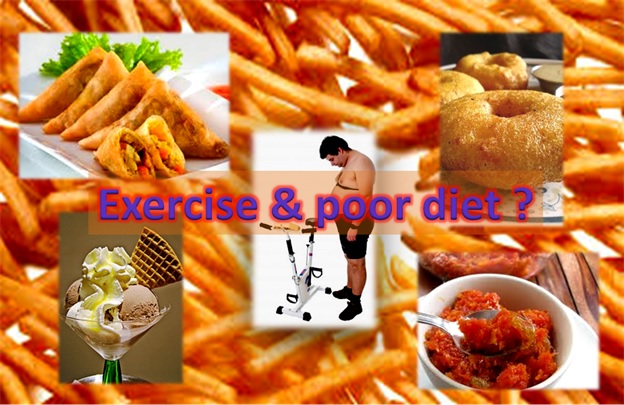
Exercise is important – but do you know just exercising and trying to lose weight is not going to have any effect? Why so?
Here is an example explained in simple terms: To lose a pound a day, you should consume between 1,200 or 1,500 calories a day depending on body weight and how much you exercise. A 135-pound person biking 60 minutes at 12 miles an hour will burn 369 calories. After your exercise, if you snack on one post-workout protein bar you will put back all the calories that you burnt few minutes back. Therefore, you can see how hard it is to exercise your way through a poor diet. Instead, you have to watch what you eat and exercise.
If you think that – “My health is good as I am consuming vegetable oil” – No – It does not work that way. PUFAs are present in unsaturated vegetable oils and too much consumption can cause more harm to body by decreasing metabolism. Polyunsaturated fats – like all fats – contain nine calories per gram, which means if you consume PUFA in moderate quantity it works better. If not, it has negative effect! They can reduce ATP level which is nothing but source of energy for metabolism. The less energy (ATP) you produce, the slower your metabolic rate, the fewer calories you burn.
What you need to do?
PUFA is present in canola, soybean, peanut, safflower, sunflower oil, and others oils. If you are consuming these oils – look at the labels and add to food accordingly.