







 Fusion
Practicing Salabhasana for a Stronger Back and Better Emotional Balance
There are certain yoga poses that one should consider including in daily yoga practice to get maximum benefits. Salabhasana, popularly known as The Locust Pose, is one such pose that helps us to keep going with a strong back, strong core and strong mind. It is a powerful backbend that strengthens the body while also promoting mental clarity and emotional balance. Derived from the Sanskrit words “Salabha” means locust or grasshopper and “Asana” for pose, this posture is widely practiced in yoga for its therapeutic benefits.
How to practice Locust Pose – Salabhasana?
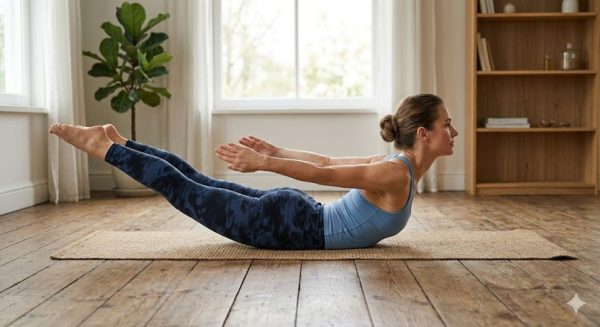
Salabhasana is a prone backbend where you lie on your stomach and lift your chest, arms, and legs off the ground using the strength of your back muscles. It is commonly included in yoga sequences to counteract the effects of prolonged sitting and poor posture.
Steps to perform locust pose:
- Starting position: Lie on your stomach with your legs extended and arms alongside your body. Rest your forehead or chin on the mat.
- Engage the body: Inhale deeply and lift your head, chest, arms, and legs off the floor. Keep your legs straight and arms reaching backward.
- Hold the pose: Maintain steady breathing. Hold for 15–30 seconds, gradually increasing with practice.
- Release: Exhale slowly and lower your body back to the mat. Rest and repeat 2–3 times.
Benefits for the body:
1. Strengthens the back and spine:
- Engages the lower back, upper back, and spinal muscles.
- Helps to alleviate mild back discomfort and supports spinal alignment.
- Improves overall posture.
2. Enhances posture:
- Counteracts the effects of prolonged sitting and slouching.
- Opens the chest and shoulders, promoting an upright stance.
3. Improves respiratory function:
- Expands the chest cavity, allowing for deeper breathing.
- Enhances lung capacity and oxygen intake.
4. Stimulates digestive organs:
- Gentle pressure on the abdomen massages internal organs.
- Supports digestion and may help relieve bloating or constipation.
5. Boosts circulation:
- It encourages better blood flow to the spine and abdominal organs.
- Enhance nutrient and oxygen delivery throughout the body.
6. Strengthens legs and glutes:
- Activates the hamstrings, gluteal muscles, and calves, improving lower-body strength and stability.
Benefits for the mind:
1. Reduces stress and anxiety-
- Deep, controlled breathing activates the parasympathetic nervous system, promoting relaxation.
- Helps lower stress hormone levels.
2. Enhances mood-
- Backbends are often associated with increased energy and emotional uplift.
- May help alleviate mild symptoms of depression.
3. Improves focus and mental clarity-
- Requires concentration and body awareness.
- Encourages mindfulness and present-moment awareness.
4. Boosts energy-
- Stimulates the nervous system, helping to combat fatigue and lethargy.
Precautions:
Avoid if pregnant or post-surgery: Because the entire weight of the body rests on the abdomen, this pose should be avoided during pregnancy.
Support the lower back: If you have a history of lower back pain or sciatica, do not push for maximum height. Instead, lift legs a little and stretch the legs.
Manage blood pressure and heart health: This pose can increase intra-abdominal pressure and briefly raise blood pressure. If you have hypertension or heart condition, practice with caution.
Image credit: Created using AI Gemini on19-4-2026
Author: Sumana Rao | Posted on: April 20, 2026
« Previous Article
Next Article »
« How to prepare for opportunities Procrastination: Causes, Effects, and Simple Ways to Overcome It »
« How to prepare for opportunities Procrastination: Causes, Effects, and Simple Ways to Overcome It »











Write a comment