





 Fusion
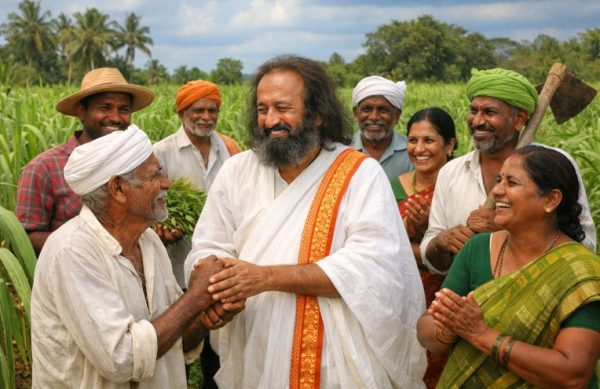
Healing the Hands That Feed Us: How Art of Living Is Supporting Indian Farmers in Critical Times
Food activism often focuses on what we eat – organic vs. chemical, local vs. industrial, plant-based vs. animal-based. But just as important is who grows our food and the emotional, psychological, and social conditions under which that food is produced. In India, where farming sustains nearly half the population, the crisis facing farmers is not only economic or environmental – it is deeply human.
Amid mounting debt, climate instability, crop failures, and social pressure, Indian farmers are facing unprecedented levels of stress, anxiety, and despair. In this fragile landscape, The Art of Living Foundation has emerged as a quiet yet powerful force – helping to heal farmers minds and hearts while restoring dignity, resilience, and hope.
The farmer crisis: beyond statistics
Discussions about Indian agriculture often center on numbers – yields, prices, rainfall deficits, suicide rates. While these figures matter, they rarely capture the emotional toll carried by farmers who wake before dawn, depending on unpredictable monsoons, and shoulder generational responsibility to feed millions.
Food activism demands that we look beyond supply chains and acknowledge that food justice includes mental wellbeing. A farmer who is emotionally exhausted cannot sustain the soil, the seeds, or the community.
Art Of Living: healing from the inside out
The Art of Living Foundation, founded by Sri Sri Ravi Shankar, works in rural India through a holistic approach that integrates mental health, stress relief, community building, and sustainable living.
1. Mental and emotional healing
Through breathing techniques, meditation, and stress-management programs, farmers are given practical tools to cope with anxiety, fear, and hopelessness. These practices help:
- Reduce chronic stress linked to debt and uncertainty
- Improve emotional regulation and sleep
- Restore self-worth and inner stability
For many farmers, this is the first time their mental health is acknowledged as something worth nurturing.
2. Rebuilding community and collective strength
Isolation is one of the most damaging aspects of the farmer crisis. Art of Living programs often bring farmers together in group sessions, creating spaces for shared healing and solidarity.
When farmers sit together, breathe together, and speak openly, shame dissolves. Community replaces isolation – a vital step toward long-term resilience.
3. Support during critical times
During droughts, floods, pandemics, and economic disruptions, Art of Living volunteers have provided:
- Emotional support and counseling
- Food relief and necessities
- Trauma-informed care during emergencies
This presence during crisis moments reinforces a powerful message: farmers are not alone.
Why does this matter? When farmers are mentally supported, they will be more open to sustainable and regenerative practices – They make healthier long-term decisions – Communities become more stable and food systems more resilient. By addressing mental health alongside agriculture, Art of Living aligns deeply with the values of ethical food systems.
Healing farmers is healing our food system: Every meal is a story – of land, labor, climate, and human emotion. When farmers are overwhelmed by stress and despair, that pain echoes through the food system.
Organizations like Art of Living remind us that true food activism is compassionate. It recognizes that healing the earth and healing the farmer must happen together.
- Supporting farmers wellbeing is not charity – it is a form of food justice.
- A call to Conscious Eating
- As consumers, activists, and storytellers, we can amplify narratives that center farmer wellbeing
- Support organizations working on mental health in agriculture
- Advocate for food systems rooted in compassion, not extraction
Because when the hands that feed us are healed, the future of food becomes more humane – and more hopeful. Food activism begins with empathy. And empathy begins with listening – not only to the land, but to the hearts of those who cultivate it.
Image credit: www.werindia.com
References:
- https://ssrdp.artofliving.org/
- https://indianconventions.in/
- https://www.theweek.in/
- https://waterconservation.artofliving.org/save-farmer-agriculture-india
Author: Sumana Rao | Posted on: January 17, 2026
« Previous Article
Next Article »
« A Mother’s Journey From Amazon Programming To Chemical Free Lifestyle How Global Food Systems Are Threatening Local Cuisines And Why It Matters »
« A Mother’s Journey From Amazon Programming To Chemical Free Lifestyle How Global Food Systems Are Threatening Local Cuisines And Why It Matters »












Write a comment